Untangling Agentic AI Protocols
AgentsWorkflowsGovernanceSafety
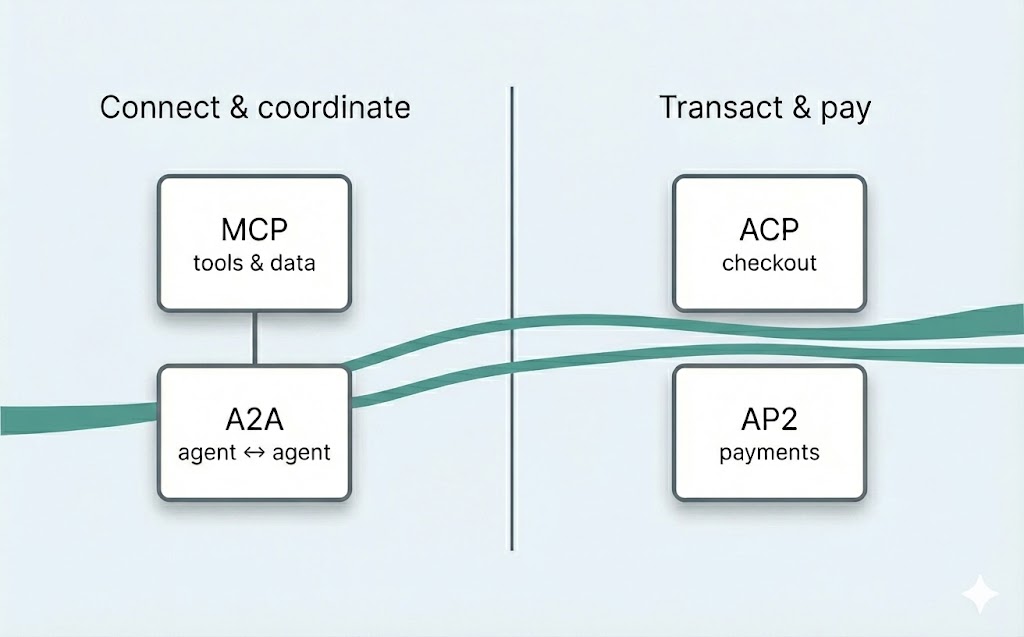
Four emerging protocols define how agents connect, coordinate, transact, and pay: MCP and A2A for connection and coordination, ACP and AP2 for commerce and payment.
As agents become part of products and services, a set of shared protocols is beginning to take shape. Four in particular are worth knowing. They can be grouped into two categories: those that govern how agents connect, and those that govern how they transact.
Connecting and coordinating
MCP (Model Context Protocol): defines how an agent can use external tools and data. First developed by Anthropic, adoption is growing across major providers.
A2A (Agent-to-Agent Protocol): sets out how agents discover and communicate with each other. Developed by Google and now stewarded by the Linux Foundation.
Transacting and paying
ACP (Agentic Commerce Protocol): describes the structure of the checkout conversation between agent and merchant. OpenAI launched it with Stripe in ChatGPT’s 'Instant Checkout', currently available only in the United States.
AP2 (Agent Payments Protocol): provides a standard way for agents to authorise and route payments, whether by card, bank transfer, or stablecoin. It was introduced by Google with industry partners as a payment-agnostic standard.
A simple way to think of them is this: MCP and A2A cover connection and coordination; ACP and AP2 cover commerce and payment. In ChatGPT, ACP currently uses Stripe, but the protocol is processor-agnostic, and many expect ACP and AP2 to evolve side by side as complementary layers.